The Tunguska Incident
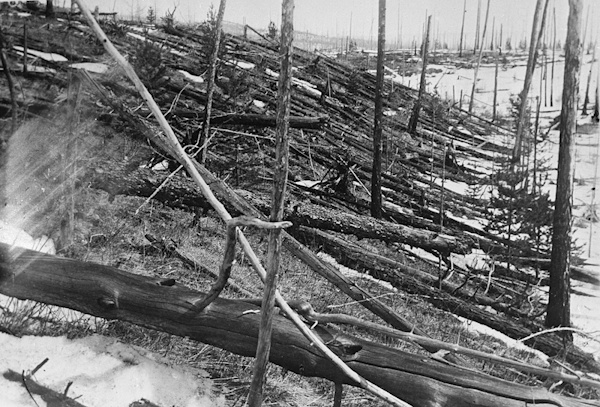
At 07:17 (local time) on the 30th of June 1908, an explosion of up to 15 megatons rocked Siberia, Russia. The epicentre appeared to be near the Podkamennaya Tunguska River, shattering windows hundreds of kilometres away, flattening 2000 square kilometres of forest, and described by locals as a "second sun" or as if "the sky split open". Glowing skies were observed across Eurasia for several nights following the incident.
The accepted theory is that a meteorite the size of a Boeing 747 exploded before it hit the ground, with the shockwave causing the damage. However, no impact crater has ever been found, and researchers found no fragments of meteoric material, nor chemical signatures consistant with known meteorites. Perhaps this is less surprising, when you consider that the first official expedition didn't arrive until 1927. Nineteen years is a long time to leave the largest explosion in recorded history uninvestigated.
If it was a meteorite, why was there no impact crater? Not even so much as a shallow indentation. Why were no fragments found if it was so massive? Why did it conviniently flatten such a large area of uninhabited forest? There's something about this incident which doesn't sit right with me.